Features / filters
Specification
PoE
The switches support 802.3at PoE+, 802.3af, 60 W PoE and Cisco prestandard PoE Maximum power 60 W to any 10/100 or Gigabit Ethernet port for PoE+ supported devices and 15.4 W for PoE supported devices until the PoE budget for the switch is reached The total power available for PoE for the switch is as follows:
Power dedicated to PoE
None
Number of ports supporting PoE
None
Green Power (mode)
Energy Detect
Energy consumption of the system
6.9 W
Energy consumption (with PoE)
N/A
Heat distribution (BTU/hr)
23.5
Total number of ports
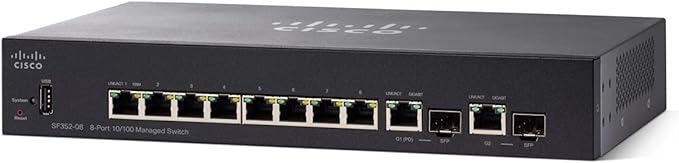
8 x Fast Ethernet + 2 x Gigabit Ethernet
Ports RJ-45
8 x Fast Ethernet
Combo ports (RJ-45 + SFP)
2 x Gigabit Ethernet Combo
LEDs
System, Link/Act, PoE, Speed, LED power saving option
Supported SFP modules
MGBSX1, MGBLH1, MGBT1
Dimensions (W x H x D)
279.4 mm x 44 mm x 170 mm
Power supply
100-240 V, 50-60 Hz, 0.7 A, external
Certification
UL (UL 60950), CSA (CSA 22.2), CE mark, FCC Part 15 (CFR 47) Class A
Ambient temperature during operation
0°C to 50°C
Ambient temperature during storage
-20°C to 70°C
Humidity during operation
10% to 90%, relative, non-condensing
Humidity during storage
10% to 90%, relative, non-condensing
MTBF @ 40C (hours)
532704
Guarantee period
Limited Lifetime Warranty, with exchange in advance the next business day (if available)
Package contents
Cisco switch 350 series Power cord or power supply Mounting kit Console cable Operating instructions
Capacity in millions of packets per second (mpps), 64-byte packets
4.17
Switching capacity in gigabits per second (Gbps)
5.6
USB connector
The USB port is used to manage files
Spanning Tree Protocol
802.1d Spanning Tree support Fast convergence using 802.1w (Rapid Spanning Tree [RSTP]), enabled by default 8 instances are supported Multiple instances of Spanning Tree using 802.1s (MSTP)
Grouping of ports
Support for IEEE 802.3ad Link Aggregation Control Protocol (LACP) ● up to 8 groups up to 8 ports per group with 16 candidate ports for each aggregated dynamic link 802.3ad LAG
VLAN
Supports up to 4096 VLANs simultaneously VLANs based on ports and tags 802.1Q VLANs based on MAC VLAN management Private VLAN Edge (PVE), also known as protected ports, with multiple uplinks VLAN guest Uncertified VLAN Dynamic VLAN assignment via RADIUS server with client authentication 802.1x CPE VLAN
Voice VLAN
Voice traffic is automatically assigned to a voice specific VLAN and processed using the appropriate levels of voice QoS Auto
Multicast TV VLAN
Multicast TV VLANs allow a single VLAN to be shared in a network, while subscribers remain in separate VLANs (also known as MVRs).
Q-in-Q VLAN
VLANs transparently intersect the network of service providers while isolating traffic among customers
Generic VLAN Registration Protocol (GVRP)/Generic Attribute Registration Protocol (GARP)
Protocols for automatic expansion and configuration of VLANs in a bridged domain
Unidirectional Link Detection (UDLD)
The UDLD monitors the physical connection to detect one-way connections caused by incorrect wiring or cable/port errors to prevent redirection loops and blocked traffic in networks
DHCP Relay in Layer 2
Forwarding DHCP traffic to a DHCP server in different VLANs; works with DHCP option 82
Internet Group Management Protocol (IGMP) versions 1, 2, 3 and snooping
IGMP limits bandwidth-intensive multicast traffic to requesters only; supports up to 1K multicast groups (source-specific multicasting is also supported)
IGMP Querier
Querier IGMP is used to operate the Layer 2 snooping switches multicast domain in the absence of a multicast router
HOL lock (Head-Of-Line)
Prevention of HOL blockades
Feedback loop detection
Feedback loop detection provides loop protection by transmitting loop protocol packets from ports where loop protection has been enabled Works independently of STP
Jumbo frames
Up to 9216 bytes
MAC board
Up to 16K (16384) MAC addresses
Routing IPv4
IPv4 packet forwarding at link speed Up to 1K static routes and up to 128 IP interfaces
Routing IPv6
IPv6 packet forwarding at Internet connection speed
Classless Inter-Domain Routing (CIDR)
CIDR support
Layer 3 interface
Layer 3 interface configuration on physical port, LGD, VLAN or loopback interface
DHCP relay on layer 3
Transmission of DHCP traffic in different IP domains
User Datagram Protocol (UDP) relay
Transferring transmission information between layer 3 domains to detect applications or transfer bootP/DHCP packets
DHCP server
Switch to act as an IPv4 DHCP server supporting IP addresses for multiple DHCP pools Support for DHCP options
Secure Shell Protocol (SSH)
SSH is a safe replacement for Telnet traffic SCP also uses SSH SSH v1 and v2 are supported
Secure Sockets Layer (SSL)
SSL support: encrypts all HTTPS traffic, allowing highly secure access to the browser-based graphical management interface on the switch
IEEE 802.1X (Authenticator roles)
802.1X: RADIUS authentication and reporting Checksum MD5 VLAN for guests Uncertified VLAN Single/multiple host mode and single/multiple sessions Supports temporary handling 802.1X Dynamic VLAN assignment
Authorisation via Internet
Network-based authentication provides control of network access via a web browser to any device or operating system
STP Bridge Protocol Data Unit (BPDU) Guard
Safety mechanism to protect the network against incorrect configurations The port with the BPDU Guard enabled is disabled if a BPDU message is received on this port
STP Root Guard
This prevents edge devices not under the control of the network administrator from becoming Spanning Tree Protocol root nodes
DHCP snooping
Filters DHCP messages with unregistered IP addresses and/or from unexpected or untrusted interfaces This prevents malicious devices from acting as DHCP servers
IP Source Guard (IPSG)
When the IP Source Guard feature is enabled on a port, the switch filters the IP packets received from the port if the source IP addresses of the packets have not been statically configured or dynamically learned from DHCP snooping This prevents the spoofing of IP addresses
Dynamic ARP Control (DAI)
The switch rejects ARP packets from the port if there are no static or dynamic IP/MAC bindings, or if there is a discrepancy between the source or destination addresses in the ARP packet This prevents man-in-the-middle attacks
IP/MAC/Port Binding (IPMB)
Previous features (DHCP Snooping, IP Source Guard and Dynamic ARP Inspection) work together to prevent DOS attacks on the network, thereby increasing network availability
Secure Core Technology (SCT)
Ensure that the switch will receive and manage processes and protocol traffic regardless of the amount of traffic received
Secure Sensitive Data (SSD)
Mechanism for secure management of sensitive data (such as passwords, keys, etc.) on the switch, filling in this data on other devices and protecting against self-configuration Access to view confidential data in plain or encrypted text is provided according to the user configured access level and user access method
Layer 2 isolation Private VLAN Edge (PVE) with community VLAN
PVE (also known as protected ports) provides layer 2 isolation between devices in the same VLAN, supports multiple uplink links
Port security
Possibility to block source MAC addresses to ports and limit the number of known MAC addresses
RADIUS/TACACS+
Supports RADIUS and TACACS authentication The switch acts as a customer
Storm protection
Broadcasting, multicast and unknown unicast
RADIUS accounting
RADIUS reporting functions allow sending data at the beginning and end of the service, indicating the amount of resources (such as time, packets, bytes, etc.) used during the session
Prevention of DoS
Prevention of Denial-Of-Service (DOS) attacks
ACL Access Control Lists
Support for up to 512 rules Packet rejection or bandwidth restriction based on source and destination MAC, VLAN ID or IP address, protocol, port, DSCP/IP priority, source and destination ports TCP/UDP, 802.1p priority, Ethernet type, Internet Control Message Protocol (ICMP) packets, IGMP packets, TCP flag, time-supported ACL
Schedules
Strict priority and Weighted Round-Robin (WRR) Queue assignment based on DSCP and service class (802.1p/CoS)
Class of service – Class of service
Port based; 802.1p VLAN based on VLAN priority; based on IPv4/v6 IP precedence/Type of Service (ToS)/DSCP; Differentiated Services (DiffServ); ACLs classification and remarking, trusted QoS
Capacity limitations – Rate limiting
Ingress policer; outbound traffic control and speed control; on VLAN, on port and based on data flow
Avoiding congestion
TCP congestion avoidance algorithm is required to minimize and avoid global synchronization of TCP losses
IPv6
IPv6 host mode IPv6 over Ethernet Dual IPv6/IPv4 stack Detection of neighbor and IPv6 (ND) router Auto-configuration of the IPv6 address Path Maximum Transmission Unit (MTU) discovery Double address detection (DAD) ICMP version 6 IPv6 over IPv4 with support for Intrasite Automatic Tunnel Addressing Protocol (ISATAP) Gold certificate USGv6 and IPv6 logo
IPv6 QoS
Prioritization of IPv6 packets
IPv6 ACL
Speed limit or IPv6 rejection
IPv6 First Hop Security
RA guard ND inspection DHCPv6 guard Table of adjacent bonds (snooping and static entries) Control of the integrity of adjacent bonds
Multicast Listener Discovery (MLD v1/2) snooping
Delivering IPv6 multicast packets only to the right recipients
IPv6 applications
Web/SSL, Telnet server/SSH, ping, traceroute, Simple Network Time Protocol (SNTP), Trivial File Transfer Protocol (TFTP), SNMP, RADIUS, syslog, DNS client, Telnet Client, DHCP Client, DHCP Autoconfig, IPv6 DHCP Relay, TACACS
Graphical user interface
Built-in switch configuration tool for easy browser-based device configuration (HTTP/HTTPS). Supports configuration, system desktop, system maintenance and monitoring
Smart Network Application (SNA)
Smart Network Application (SNA) is an innovative network level monitoring and management tool built into the Cisco 100 to 500 series switches. Can detect network topology, display link status, monitor events, apply configurations and update software images using multiple switches on the network (Note: Network management with Smart Network Application requires the use of the 350, 350X or 550X series switch as part of the network)
SNMP
SNMP versions 1, 2c and 3 with SNMP trap support and SNMP version 3 User based security model (USM)
Remote monitoring (RMON)
RMON embedded software supports 4 RMON groups (history, statistics, alarms and events) for better traffic management, monitoring and analysis
Dual IPv4 and IPv6 stack
Coexistence of both piles of protocols to facilitate migration
Firmware update
Upgrade via web browser (HTTP/HTTPS) and TFTP and upgrade via SCP launched by SSH The update can also be initiated by the console port Dual images for flexible firmware updates
Port mirroring
Traffic at a port can be reflected in another port for analysis using a network analyser or RMON probe Up to 8 source ports can be mirrored to one destination port A single session is supported
VLAN mirroring
Traffic from the VLAN can be reflected in the port for analysis using a network analyser or RMON probe Up to 8 source VLANs can be mirrored to one destination port A single session is supported
DHCP (options 12, 66, 67, 82, 129 and 150)
DHCP options allow tighter control from a central point (DHCP server) to obtain the IP address, auto-configuration (with download of configuration file), DHCP relay and host name
Secure copy (SCP)
Securely transfer files to and from the switch
Auto-configuration with secure copying (SCP)
Enables secure, mass deployment with protection of sensitive data
Text-based, editable configuration files
Configuration files can be edited with a text editor and downloaded to another switch to facilitate mass deployment
Smartports
Simplified configuration of QoS and safety functions
Auto Smartports
Uses intelligent solutions delivered through Smartport roles and applies them automatically to the port based on devices detected by Cisco Discovery Protocol or LLDP-MED
CLI
Command line scripting interface The full CLI interface is supported, as well as the menu-based CLI interface User rights levels 1, 7 and 15 are supported for CLI
Cloud services
Support for Cisco Small Business FindIT Network
Other forms of management
Traceroute; single IP management; HTTP/HTTPS; SSH; RADIUS; port mirroring; TFTP update; DHCP client; BOOTP; SNTP; Xmodem update; cable diagnostics; ping; syslog; Telnet client (secure SSH support)
Temporary use of the port
Lifting or deactivating the port based on a user-defined schedule (when the port is administratively lifted)
PoE based on a timetable
Power on/off capability based on a user-defined schedule
Compliance with EEE (802.3az)
Support for 802.3az on all copper ports (SG350 models)
Energy detection
The switch automatically turns off the power to the Gigabit Ethernet port and 10/100 RJ-45 port when no connection is detected. Power supply resumes without packet loss when the switch detects a connection
Switching off port LEDs
LEDs can be manually switched off to save energy
Cable length detection
Adjusts signal strength depending on cable length for Gigabit Ethernet models, reduces power consumption for cables shorter than 10 m
Bonjour
The switch is broadcast via Bonjour protocol
Link Layer Discovery Protocol (LLDP) (802.1ab) with LLDP-MED extensions
LLDP allows the switch to broadcast its identification, configuration and capabilities to adjacent devices that store data in MIB LLDP-MED is an LLDP extension that adds extensions needed for IP phones
Cisco Discovery Protocol
- The switch is broadcast via the Cisco Discovery Protocol You also learn about the connected device and its properties using the Cisco Discovery Protocol




There are no reviews yet.