
,

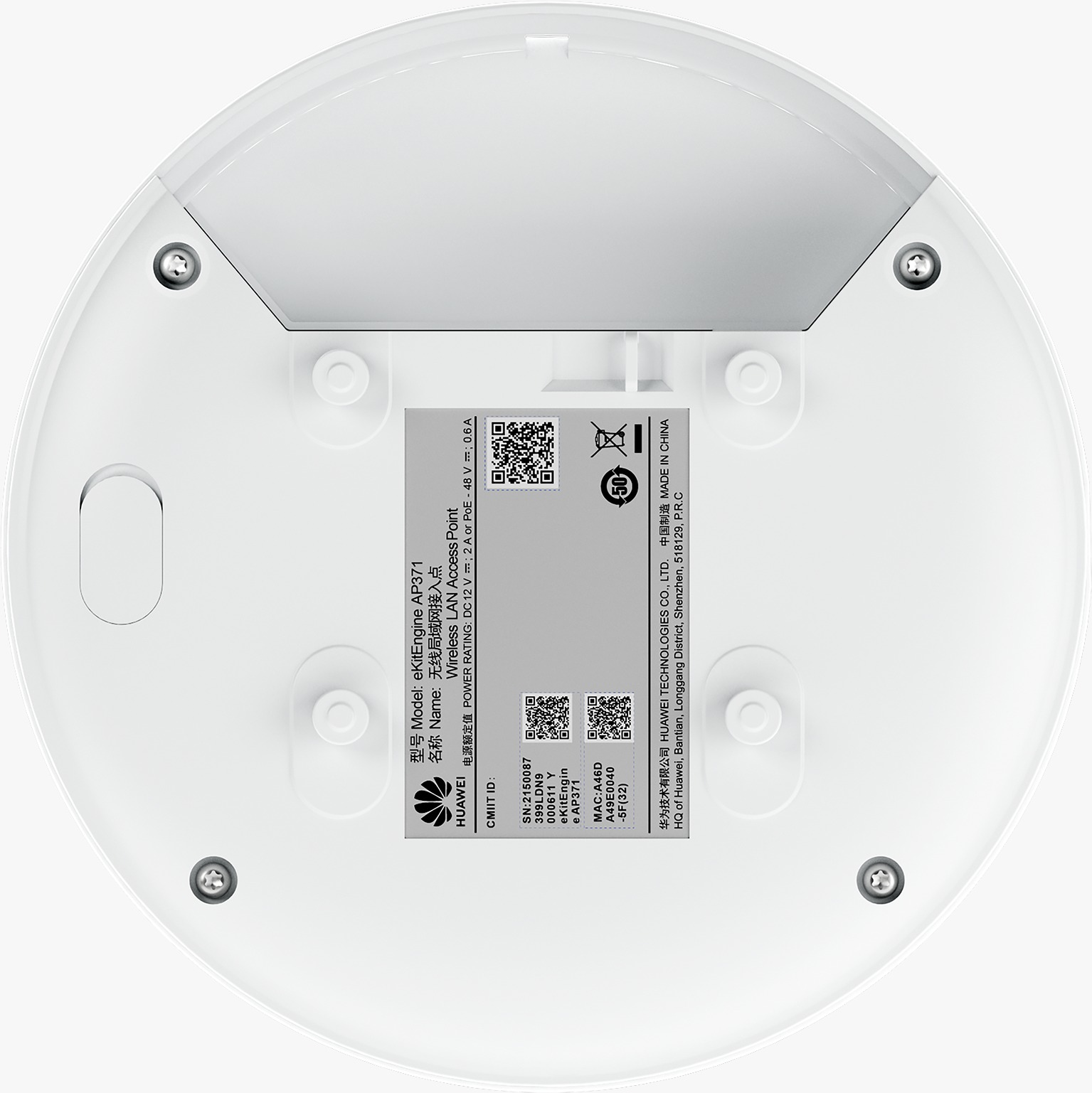
Huawei eKitEngine AP371 Wi-Fi 7 Access Point


  • Huawei eKitEngine AP371 Wi-Fi 7 Access Point
  •  BE3600 Dual-Band 2.5GE Settled AP
  •  Wi-Fi 7 vs. Wi-Fi 6
  •  eKitEngine AP371 is a next-generation indoor access point (AP) in compliance with Wi-Fi 7
    (802.11be). It can simultaneously provide services on 2.4 GHz (2×2 MIMO) and 5 GHz (2×2 MIMO)
    frequency bands, supporting a total of 4 spatial streams and achieving a device rate of up to 3.57 Gbps.
  • Max. 256 access users
  • 150 access users recommended

7,319 EGP

Huawei eKitEngine AP371 Wi-Fi 7 Access Point

  • Feature Descriptions
  • Wi-Fi 7 (802.11be) standard
    Wi-Fi 7 (802.11be) is the next-generation Wi-Fi standard to be launched, also known as IEEE 802.11be or
    extremely high throughput (EHT). Based on Wi-Fi 6, Wi-Fi 7 introduces technologies such as 320 MHz
    bandwidth, 4096-quadrature amplitude modulation (QAM), multi-resource unit (RU), multi-link operation
    (MLO), enhanced multi-user multiple-input multiple-output (MU-MIMO), and multi-AP coordination.
    Drawing on these cutting-edge technologies, Wi-Fi 7 delivers a higher data transmission rate and lower
    latency than Wi-Fi 6. The network throughput of Wi-Fi 7 is expected to increase to more than 30 Gbps,
    about three times that of Wi-Fi 6.
    Wi-Fi 7 vs. Wi-Fi 6
    Based on the Wi-Fi 6 standard, Wi-Fi 7 introduces a plurality of new technologies. The following compares
    Wi-Fi 6 and Wi-Fi 7.
  • New Features in Wi-Fi 7
    Wi-Fi 7 aims to increase the WLAN throughput to over 30 Gbps and provide low-latency access assurance.
    To achieve this goal, the standard defines modifications to both the physical layer (PHY) and MAC layer.
    Compared with Wi-Fi 6, Wi-Fi 7 brings the following technical innovations:
    Multi-RU*
     In Wi-Fi 6, each user can send or receive frames only on the RUs allocated to them, which greatly
    limits the flexibility of spectrum resource scheduling. To resolve this problem and further improve
    spectrum efficiency, Wi-Fi 7 defines a mechanism for allocating multiple RUs to a single user. To
    balance the implementation complexity and spectrum utilization, the standard specifications impose
    certain restrictions on RU combination. That is, small RUs (containing fewer than 242 tones) can be
    combined only with small RUs, and large RUs (containing greater than or equal to 242 tones) can be
    combined only with large RUs. Small RUs and large RUs cannot be combined together.
    Features marked with asterisks (*) can be implemented through software upgrade.
    Higher-Order 4096-QAM
    The highest order modulation supported by Wi-Fi 6 is 1024-QAM, which allows each modulation
    symbol to carry up to 10 bits. To further improve the rate, Wi-Fi 7 introduces 4096-QAM so that each
    modulation symbol can carry 12 bits. With the same coding scheme, 4096-QAM in Wi-Fi 7 can
    achieve a 20% rate increase compared with 1024-QAM in Wi-Fi 6.
    Multi-Link Mechanism
    To efficiently utilize all available spectrum resources, the TGbe defines multi-link aggregation
    technologies, including the MAC architecture of enhanced multi-link aggregation, multi-link channel
    access, and multi-link transmission.
    Multi-AP Coordination*
    In the current 802.11 protocol framework, there is not much coordination between APs. Common
    WLAN functions, such as automatic radio calibration and smart roaming, are vendor-defined features.
    Multi-AP coordination aims to optimize channel selection and adjust loads between APs to achieve
 

Categories: , Brand:
Item Specification
Installation Type
  • Wall
  • Ceiling
  • T-Rail
Dimensions without packaging (H x W x D) [mm(in.)] Diameter x depth: 180 mm x 35 mm (7.09 in. x 1.38 in.)
Dimensions with packaging (H x W x D) [mm(in.)] 61 mm x 231 mm x 203 mm (2.40 in. x 9.09 in. x 7.99 in.)
Weight without packaging [kg(lb)] 0.47 kg (1.04 lb)
Weight with packaging [kg(lb)] 0.69 kg (1.52 lb)
Storage NAND Flash 256 MB
Console port Bluetooth serial port (reserved only)
Maximum power consumption [W] 13.60 (excluding USB)
Maximum heat dissipation [BTU/hour] 44.1 BTU/hour
Power supply mode
  • PoE
  • DC power adapter
Rated input voltage [V] 12 V
Input voltage range [V] DC: 12 V ± 10%

PoE: 802.3at/af

Service port surge protection PoE port:

Differential mode (48 V-RTN): 0.5 kV (1.2/50 us, 42 ohms), criterion B

Common mode (8 wires to ground): 4 kV (1.2/50 us, 42 ohms), criterion B

Maximum number of physical ports on the entire device 2.5GE (RJ45) x 1, 100M/1000M/2500 Mbit/s auto-sensing
Long-term operating temperature [°C(°F)] –10°C to +50°C (14°F to 122°F) (From 1800 m to 5000 m [5905.51 ft. to 16404.20 ft.], the maximum temperature of the device decreases by 1°C [1.8°F] for every 300 m [984.25 ft.] increase in altitude.)
Storage temperature [°C(°F)] –40°C to +70°C (–40°F to +158°F)
Long-term operating relative humidity [RH] 5% RH to 95% RH (non-condensing)
Long-term operating altitude [m(ft.)] –60 m to +5000 m (–196.85 ft to +16404.20 ft)
Atmospheric pressure [kPa] 53kPa – 106kPa ETSI 300 019-2-3
Ground floating ground
USB The USB function is unavailable and will be supported through software upgrade in the future.
BLE BLE5.4
Radio number 2
Operating frequency band
  • 2.4GHz
  • 5GHz
MIMO spatial streams Radio 0 (2.4 GHz): 2×2

Radio 1 (5 GHz): 2×2

Wi-Fi standard 2.4 GHz: 802.11b/g/n/ax/be

5 GHz:802.11a/n/ac/ac Wave 2/ax/be

Radio interface Built-in smart antennas
Antenna gain 2.4 GHz:

4 dBi/chain (peak gain)

1 dBi (combined gain)

5 GHz:

5 dBi/chain (peak gain)

3 dBi (combined gain)

BLE: 4 dBi (peak gain)

Maximum transmit power 2.4 GHz:

20 dBm/chain

23 dBm (combined power)

5 GHz:

20 dBm/chain

23 dBm (combined power)

Singal radio transmit power [dBm] 2.4G: -10 dBm to 20 dBm/chain

5G: -10 dBm to 20 dBm/chain

MTBF [year] 158.215 year
MTTR [hour] 2 hour
Frequency stability [ppm] +/-20
802.3at power supply description No function is limited.
802.3af power supply description The USB function is not supported. Other functions are not restricted.
DC power supply description No function is limited.

Based on 0 reviews

0.0 overall
0
0
0
0
0

Be the first to review “Huawei eKitEngine AP371 Wi-Fi 7 Access Point”

There are no reviews yet.

SHOPPING CART

close
Let's Chat!